Traffic Signs in India: Complete Guide to Road Signs & Meanings (IRC 67)
An authoritative technical breakdown of Mandatory, Cautionary, and Informatory traffic signs codified by the Indian Roads Congress.
What are Traffic Signs?
Traffic signs are standardized visual devices erected beside or above roadways to convey instructions, warnings, and navigational guidance to motorists and pedestrians. On the diverse and rapidly expanding Indian road network, traffic signs serve as the primary language of road discipline, directly regulating vehicle speeds, preventing collisions, and ensuring predictable traffic flow.
In India, the design, dimensions, symbols, colors, and retro-reflective standards of all road signs are codified by the Indian Roads Congress in its authoritative standard IRC 67: Code of Practice for Road Signs.
The Three Main Categories of Traffic Signs in India
Under IRC 67 and the Motor Vehicles Act, traffic signs across India are classified into three primary functional groups:
1. Mandatory / Regulatory Signs
Legally binding signs that direct what road users must or must not do. Disobeying them is an offense under the law. Mostly circular with red borders.
2. Cautionary / Warning Signs
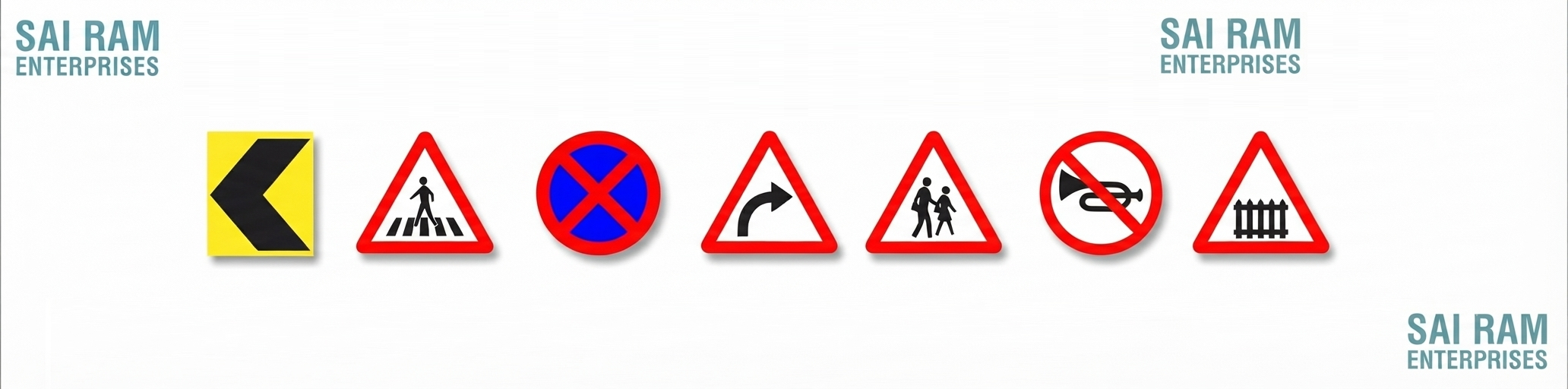
Advise road users of upcoming hazards or changing road conditions ahead. Equilateral triangles with red borders and white or yellow backgrounds.
3. Informatory / Guide Signs
Guide road users along routes, inform them of destinations, distances, route numbers, and public facilities. Rectangular boards in green, blue, or yellow.
Mandatory Signs Explained
Mandatory signs instruct drivers on statutory rules. With two notable geometric exceptions—the Octagonal STOP sign and the Inverted Triangular GIVE WAY sign—all mandatory signs are circular.
- STOP (R-1): Requires complete vehicle cessation before entering major traffic streams.
- GIVE WAY (R-2): Requires motorists to yield right-of-way to circulating traffic.
- NO ENTRY & ONE WAY (R-3, R-4): Regulates flow direction to prevent head-on crashes.
- SPEED LIMIT (R-14): Restricts vehicle speed to the indicated numerical maximum.
Cautionary / Warning Signs Explained
Cautionary signs give motorists advance notice to reduce speed and prepare for roadway hazards. Standardized as equilateral triangles with apex pointing upward, they notify drivers of sharp curves, steep ascents, narrow bridges, pedestrian crossings, speed breakers, and animal crossings.
Proper placement distance prior to the hazard depends on vehicle operating speed, ranging from 45 meters in urban areas up to 180 meters on high-speed national expressways.
Informatory Signs, Shapes & Colors
Informatory signs feature distinct color coding established by IRC 67 to create intuitive recognition:
| Sign Category / Road Type | Shape | Background Color | Lettering / Symbol Color |
|---|---|---|---|
| National & State Highways | Rectangular | Traffic Green | White Retro-Reflective |
| Expressways & Urban Roads | Rectangular | Traffic Blue | White Retro-Reflective |
| Facility Information (Hospitals, Fuel) | Rectangular / Square | Traffic Blue | White / Red Symbol |
| Rural & Other District Roads | Rectangular | Traffic Yellow | Black |
The Importance of IRC 67 Standards in Manufacturing
Manufacturing traffic sign boards is an engineering discipline requiring strict adherence to Indian Roads Congress norms. Substandard signs that use commercial grade films or incorrect non-compliant typefaces degrade rapidly under sun exposure and fail to reflect headlights at night, directly endangering road users.
At Sai Ram Enterprises, all traffic sign boards are fabricated in Bangalore according to IRC 67 specifications using high-grade microprismatic sheeting.
Frequently Asked Questions
Related Products & Signage Categories
Need Custom Sign Boards or Road Safety Quotes?
Sai Ram Enterprises supplies IRC 67 compliant traffic sign boards and road safety solutions across India.